
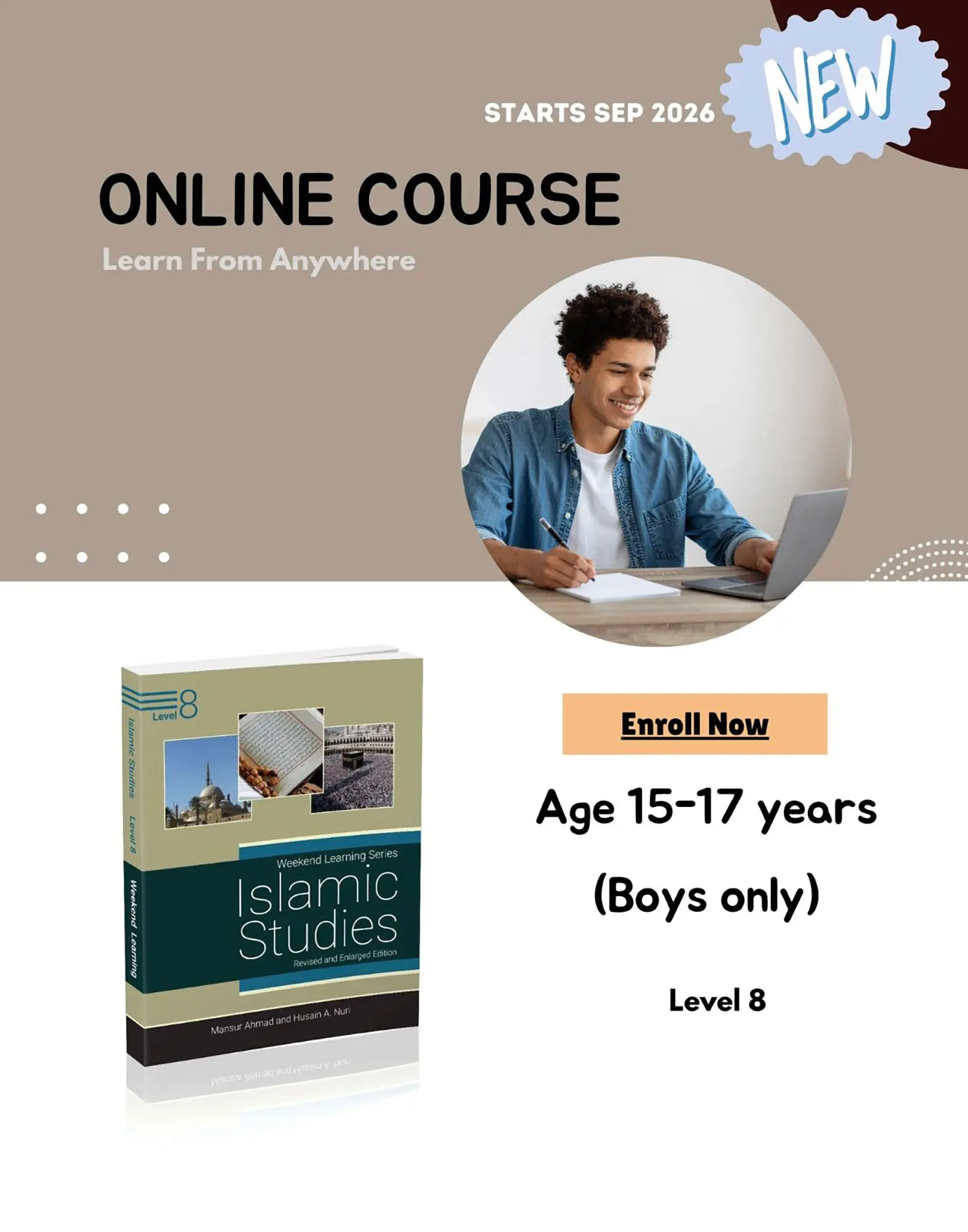
Online Course – Level 8 (Boys)
Original price was: £110.00.£99.00Current price is: £99.00.
Book early and pay £99 for the course.
The fee will increase to £110 after 25th July.
Weekend Learning Islamic Studies Teaching Schedule (Level 8)
September 2026 to December 2026
Prepared for a reflective teenage class with discussion-based learning, practical application and contemporary relevance.
Online Course – Level 8 (Boys)
Age Group: 15–17 years
Class Time: Saturdays (Weekend Learning Series)
Duration: 50 minutes
Maximum Class Size: 8 students
Term Dates and Fees (2026–2027)
Term 1
Schedule: Every other Saturday
Dates: 19th September to 12th December 2026
Sessions: 6
Cost: £110
Taught by Ustad Abu Shama
Course Description
Anchored: Navigating Life with Faith, Character & Purpose
“An anchor keeps a ship from drifting. Faith keeps a person from losing their way.”
Anchored: Navigating Life with Faith, Character & Purpose is an interactive discussion-based course designed for young Muslim men aged 14–17 who want to explore life’s biggest questions through the lens of Islam.
Together we will explore:
- How do we know what is true?
- Why do we believe in Allah?
- What makes Prophet Muhammad ﷺ worthy of following?
- What is the purpose of life?
- How do we build strong character?
- How do we deal with doubts, temptations, and setbacks?
- What does success really look like?
Drawing upon the Qur’an, Sunnah, and the rich intellectual and spiritual tradition of Islam, students will develop a deeper understanding of their faith while learning how to navigate the challenges of modern life with confidence and purpose.
This is not a lecture led series. It is a space to think, discuss, question, reflect, and grow together.
Through conversation, activities, and guided reflection, students will learn how to remain anchored in faith while charting a course toward a meaningful life.
About the Instructor
Ustadh Abu Shama is an educator, author, parent, and lifelong student of the Islamic tradition with a passion for helping young Muslims connect faith to everyday life.

Drawing upon years of teaching, and personal study, he is committed to creating engaging learning environments where young people feel comfortable asking questions, exploring ideas, and developing a thoughtful and confident understanding of Islam.
His teaching style combines traditional Islamic scholarship with discussion, reflection, and practical application, helping students move beyond simply learning information to developing faith, character, and purpose.
Through this course, he hopes to equip young Muslim with the tools they need to navigate life with conviction, resilience, and a strong connection to Allah and His Messenger ﷺ.
Suggested Teaching Approach
For this age group, the sessions work best when they are:
- Discussion based rather than lecture heavy.
- Connected to real teenage experiences.
- Focused on identity, purpose and navigating modern society.
- Built around reflection and action.
- Linked to Qur’an, Sunnah and contemporary challenges.
Each session can include:
- Icebreaker or current issue discussion.
- Main teaching from the book.
- Qur’anic reflection.
- Real life case study.
- Group discussion.
- Action point for the week.
50 minutes online.
Autumn Term Schedule 2026
Session 1
Saturday 19 September 2026
12:30pm to 1:20pm
Session 1
How Do You Know What Is True?
Big Question
- How do you know something is true?
- Can something be true even if you cannot see it?
- What counts as evidence?
- Can everyone be right?
Discussion
Before we ask, “What do Muslims believe?” we must first ask, “How do human beings come to know anything?”
This session introduces students to the question of knowledge itself and lays the foundation for the rest of the course.
Are There Different Ways of Knowing?
Explore:
- Senses
- Reason
- Testimony
- Revelation
- Intuition
- Experience
- Memory
- Consensus
Learning
Introduction to epistemology and the Islamic theory of knowledge.
Eight ways of knowing.
Activity
Optical illusions and thought experiments.
Evaluate claims using different sources.
Outcome
Students appreciate that knowledge has sources and limits.
Understanding why revelation is a valid source of knowledge.
Session 2
Saturday 3 October 2026
What Does It Mean To Be Muslim?
Big Question
What makes someone a Muslim?
Learning
The Hadith of Jibril.
Discussion
- Islam
- Iman
- Ihsan
Activity
Build a “Muslim Identity Pyramid.”
Outcome
Understand the three dimensions of religion. Plus eschatology
Session 3
Saturday 17 October 2026
What Do Muslims Believe?
Big Question
What happens if your beliefs are wrong?
Learning
Six Pillars of Faith overview.
Discussion
- Allah
- Angels
- Books
- Messengers
- Last Day
- Destiny
Activity
Belief mapping.
- Seeing Allah
- The who idea is to have Allah, his Names and attributes as a schema of life
Outcome
Big picture of Aqidah.
Half Term Break
No Class
24 October – 1 November 2026
Session 4
Saturday 14 November 2026
The Case for God
Big Question
Why is there something rather than nothing?
Learning
The case for God.
Discussion
- Cause and effect
- Necessary existence
- Design
- Purpose
- Simulation argument
Big Question
If Allah exists, how do we know Him or about Him?
Who is Allah?
Learning
- Necessary attributes
- Impossible attributes
- Surah Ikhlas
Discussion
- Why can’t Allah be human?
- Why can’t Allah have needs?
Activity
Some questions about God and seeming paradoxes
Outcome
Understanding Tawhid
How Can We Know Allah?
Big Question
Can you know someone you cannot see?
Learning
- Names and Attributes
- Signs of Allah
- Reflection
Discussion
- Relationship vs information
- Knowing about Allah vs knowing Allah
Activity
Reflection journal.
Outcome
Beginning a personal relationship with Allah.
Session 5
Saturday 28 November 2026
Why Should We Believe Prophet Muhammad ﷺ?
Big Question
How do we know Muhammad ﷺ was telling the truth?
Learning
Evidence for Prophethood.
Discussion
- How do we know he is prophet
- What’s so special about the prophet
- Character
- Quran
- Predictions
- Transformation of society
Activity
Historical investigation.
Outcome
Confidence in Prophethood.
Session 6 Sat 12th Dec
Why Follow the Prophet ﷺ?
Big Question
Why can’t we just follow the Quran alone?
Learning
Role of Prophethood.
Discussion
- Teacher and Example
- Interpreter and Implementer
- Nurturer and purifier
Activity
How do we build a relationship with the prophet
How do we love him (following him)
Outcome
Understanding Sunnah.
Essential
Meet up once or twice in town
Optional End of Term Additions
You may also include:
- Hot chocolate reflection evening.
- Student presentations.
- Team quiz.
- Charity or community project.
Suggested Homework Between Sessions
Because the classes are fortnightly, small reflective tasks help maintain connection:
- One short Qur’an reflection.
- Podcast or lecture clip.
- Journal question.
- Practical challenge.
- Family discussion task.
- Habit tracker.
Teaching Notes
For this age group especially:
- Keep discussions respectful but honest.
- Allow students to ask difficult questions safely.
- Focus on understanding before memorisation.
- Build emotional connection to Islam.
- Link every topic to action and personal growth.
The aim is not simply information, but transformation.
Related products
-
Online Course – Level 5 (Boys 10-14)
Price range: £55.00 through £190.00Select options This product has multiple variants. The options may be chosen on the product page -
Reviews
There are no reviews yet.