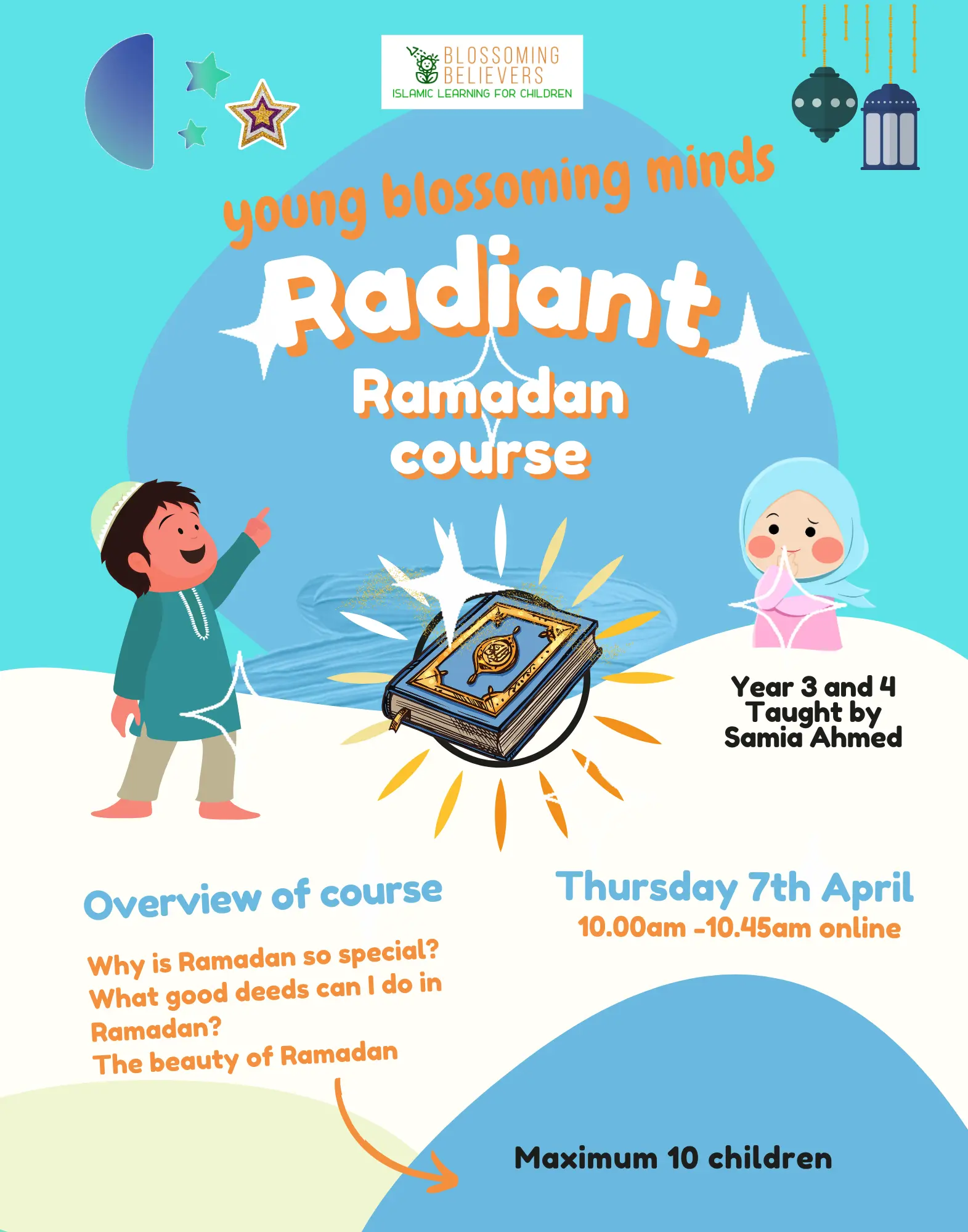
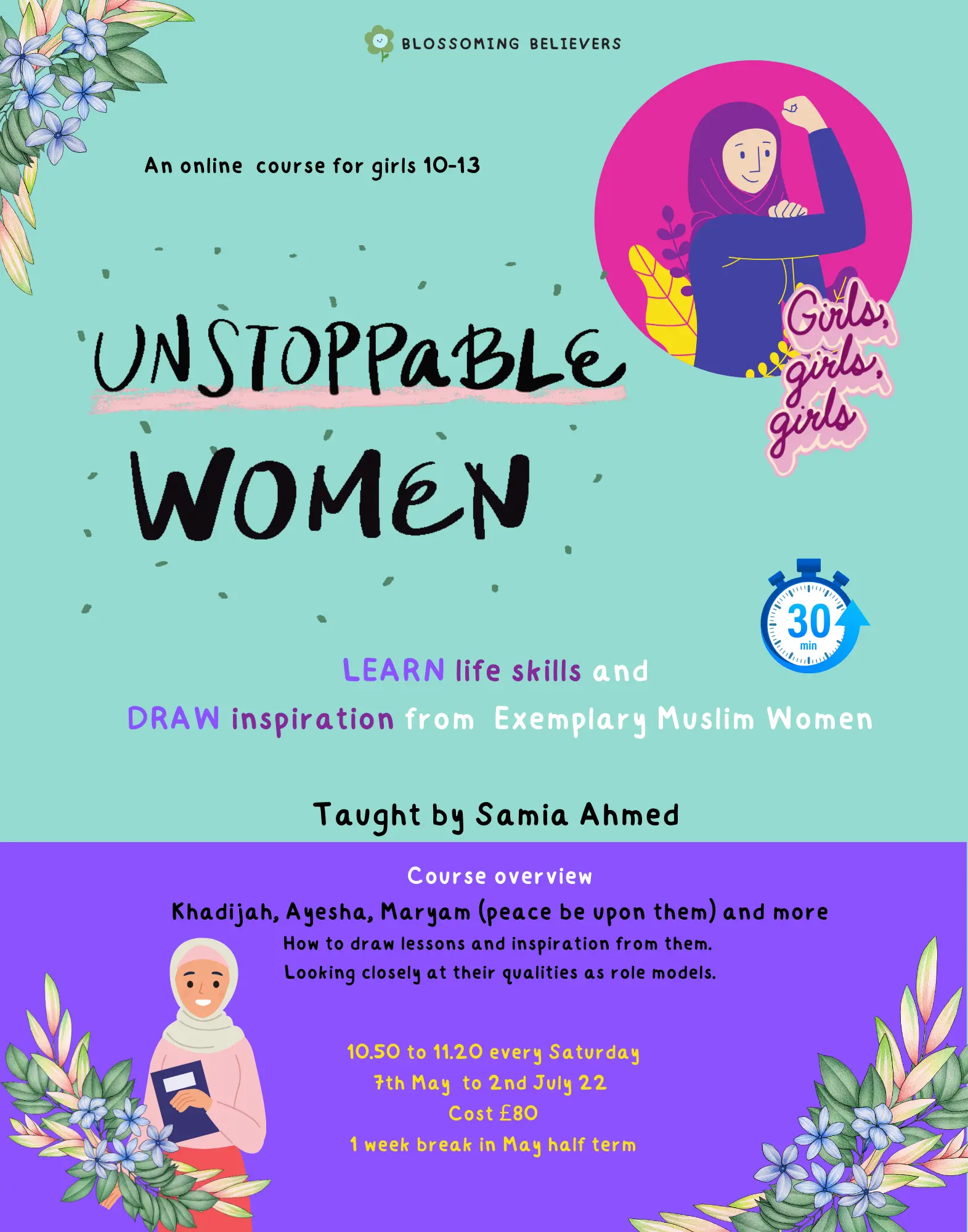
£165.00–£180.00Price range: £165.00 through £180.00
Foundation Qur’an Lessons – Book 1 & Book 2
Our Foundation Qur’an Programme gives children a gentle, confidence-building start to their Qur’an journey. We teach at a slow, steady and thoughtful pace. There is no rush to “finish” the Qur’an. Instead, we nurture a lifelong love for Allah’s Book so it becomes a true companion, in shā’ Allāh.
Book 1: Arabic Alphabet Foundations
Ideal for beginners, Book 1 helps children build strong basics. They will learn:
The full Arabic alphabet
Letters in all their positions (isolated, beginning, middle, end)
The short vowels: fatḥah, kasrah, ḍammah
Blending sounds to read simple words
Early pronunciation awareness and confidence
By the end of Book 1, learners can recognise and read beginner-level Arabic words with clarity.
Book 2: Building Fluency and Tajwīd Basics
Book 2 strengthens reading skills and prepares students for Juz ‘Amma. Children will cover:
Sukūn
Fatḥatayn, kasratayn, ḍammatazyn
Wāw līn and Yā’ līn
Alif madd, Wāw madd, Yā’ madd
Shaddah
Longer words and short āyāt
Repetition whenever needed for full mastery
Our approach remains gradual, calm and child-centred, ensuring confidence at every stage.
Juz ‘Amma Recitation Class
Once students complete Books 1 and 2, they move into the Juz ‘Amma class where they recite with correct tajwīd and a beautiful attitude towards the Qur’an. Children will:
Recite Juz ‘Amma with teacher-guided correction
Apply foundational tajwīd rules, including madda, ikhfā’, idghām, qalqalah and ghunnah
Strengthen fluency, flow and pronunciation
Explore the overall meaning of each sūrah they recite, helping them connect heart and mind
Develop a personal love and reverence for the Qur’an
Lessons run as 30-minute live online sessions once a week.
Select options
This product has multiple variants. The options may be chosen on the product page
Our Foundation Qur’an Programme gives children a gentle, confidence-building start to their Qur’an journey. We teach at a slow, steady and thoughtful pace. There is no rush to “finish” the Qur’an. Instead, we nurture a lifelong love for Allah’s Book so it becomes a true companion, in shā’ Allāh.
Book 1: Arabic Alphabet Foundations
Ideal for beginners, Book 1 helps children build strong basics. They will learn:
The full Arabic alphabet
Letters in all their positions (isolated, beginning, middle, end)
The short vowels: fatḥah, kasrah, ḍammah
Blending sounds to read simple words
Early pronunciation awareness and confidence
By the end of Book 1, learners can recognise and read beginner-level Arabic words with clarity.
Book 2: Building Fluency and Tajwīd Basics
Book 2 strengthens reading skills and prepares students for Juz ‘Amma. Children will cover:
Sukūn
Fatḥatayn, kasratayn, ḍammatazyn
Wāw līn and Yā’ līn
Alif madd, Wāw madd, Yā’ madd
Shaddah
Longer words and short āyāt
Repetition whenever needed for full mastery
Our approach remains gradual, calm and child-centred, ensuring confidence at every stage.
Juz ‘Amma Recitation Class
Once students complete Books 1 and 2, they move into the Juz ‘Amma class where they recite with correct tajwīd and a beautiful attitude towards the Qur’an. Children will:
Recite Juz ‘Amma with teacher-guided correction
Apply foundational tajwīd rules, including madda, ikhfā’, idghām, qalqalah and ghunnah
Strengthen fluency, flow and pronunciation
Explore the overall meaning of each sūrah they recite, helping them connect heart and mind
Develop a personal love and reverence for the Qur’an
Lessons run as 30-minute live online sessions once a week.
Understanding Puberty & Personal Hygiene – Guided by Faith and Confidence
Saturday, 7th February 2026 | 10.30am – 12:00pm
This specially designed online session supports young girls in understanding the changes they’ll experience during puberty which is delivered in a respectful, age-appropriate, and faith-guided environment. The course blends essential health education with Islamic values to help girls grow in confidence and self-awareness.
Taught by:
Dr Ferhat Uddin(Liberty Clinic)
A GP with a special interest in women’s health, committed to educating girls and women on their bodies with clarity and compassion.
Samia Ahmed(Blossoming Believers)
A dedicated youth educator helping young Muslim girls embrace their development through engaging, faith-based learning.
Course Objectives
By the end of this session, participants will be able to:
Recognise when puberty begins and what early signs to expect
Understand the typical age range and how the body begins to change.
Identify key physical, emotional, and mental changes during puberty
From mood swings to body growth, changes are explained in a calm and reassuring way.
Understand specific changes for girls, including menstruation and breast development
Learn what’s normal, what to expect, and how to prepare confidently.
Discover healthy coping strategies for the changes ahead
Practical tips for managing emotions, maintaining body care, and staying positive.
Explore how to worship Allah during menstruation
Learn what is permitted, what is not, and how to maintain a spiritual connection.
Practise excellent personal hygiene habits
Guidance on daily cleanliness routines, menstrual care, and overall hygiene.
Build a positive body image and self-respect in line with Islamic values
Encouraging modesty, dignity, and self-acceptance.
Debunk myths and separate fact from fiction
Clear, honest discussion to address common misconceptions around puberty and menstruation.
Know who to turn to for guidance and support
Learn how to approach trusted adults or professionals when needed.
Who is this course for?
Girls aged 9–14, who wish to approach puberty in a supportive, Islamic, and informative way.
This is more than just a class – it’s a space to grow, ask questions, and gain confidence during a key stage of life.
Places are limited – register now to secure your spot!
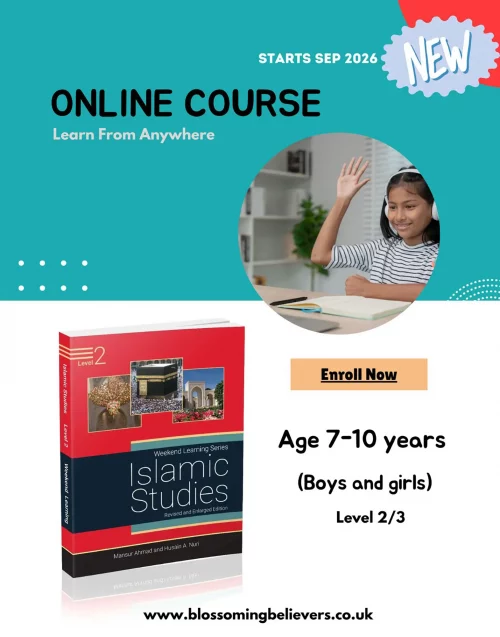
Age Group: Primary (Years 3 to 5) – (7-9 years old) Class Time: Saturdays (Weekend Learning Series) Duration: 45 minutes Maximum Class Size: 8 students
Course Overview
This course is part of the Weekend Learning Series and is designed to nurture a strong foundation in Islam for younger students in a way that is engaging, structured, and easy to understand.
Through carefully organised thematic units, students will explore key areas of Islamic belief, worship, and character. They will learn about Allah and His message, understand the importance of the Qur’an, and gain a clear introduction to the Five Pillars of Islam. The course also introduces them to the stories and character of the Messengers, helping them connect with Islamic role models from an early age.
A strong emphasis is placed on adab (manners) and akhlaq (character), encouraging children to develop kindness, respect, and good behaviour rooted in the Qur’an and Sunnah.
Each lesson is designed with young learners in mind. Sessions begin with a short colouring activity to help children settle, followed by simple, focused teaching with clear concepts. Interactive review sections reinforce learning, and optional homework allows children to continue their learning at home.
No prior attendance is required – students can join at the beginning of any term.
Topics Covered
Unit 1: The Creator and His Message
Unit 2: Our Ibadah (The Five Pillars of Islam)
Unit 3: The Character of the Messengers
Unit 4: Understanding Islam (Foundations for Young Muslims)
Unit 5: Adab and Akhlaq
Course Objective
To build a strong and confident foundation in Islamic belief, worship, and character, helping students understand who Allah is, how to worship Him, and how to behave as young Muslims—while developing love for the Qur’an and the Sunnah of the Prophet ﷺ.
Term Breakdown and Lesson Objectives
Term 1
The Creator and His Message
Children will learn about Allah as their Creator and understand that He is One, All-Powerful, and Merciful. They will be introduced to Islam as a way of life and begin to understand what it means to have faith. This unit helps children build a strong connection with Allah from an early age.
Belief in the Qur’an
Children will learn that the Qur’an is the كلام of Allah and a guide for how we live. They will understand why we respect the Qur’an and how it teaches us right from wrong. This lesson encourages love and appreciation for the Qur’an.
Term 2
Our Ibadah (The Five Pillars of Islam)
Children will learn about the Five Pillars of Islam in a simple and engaging way. They will understand the importance of Shahadah, Salah, Zakah, Sawm, and Hajj, and how these acts of worship bring us closer to Allah.
Understanding Islam (Foundations)
Children will explore basic Islamic concepts relevant to their daily lives, helping them understand how to live as young Muslims. This unit builds awareness of Islamic identity and practice in a simple and relatable way.
Term 3
The Character of the Messengers
Children will learn about some of the Messengers of Allah and their beautiful qualities such as honesty, patience, and trust in Allah. These stories inspire children to develop strong character and follow good examples.
Adab and Akhlaq
Children will learn good manners and behaviour from the Qur’an and Sunnah. They will understand how to treat others with kindness, respect, and honesty. This unit helps shape positive character and everyday behaviour.
Class Activities
Colouring starter activity to help children settle
Interactive topic-based discussions
Short concept-based learning (age-appropriate)
In-class review and reinforcement
Optional homework tasks
Textbook required (workbook recommended for extended practice)
Term Dates and Fees (2026–2027)
Term 1
Schedule: Every other Saturday Times: 11.30am to 12:15pm Dates: 19th September 2026 to 12th December 2026 Sessions: 6-7 Teaching dates:
19th September 2026
3rd October 2026
17th October 2026
31st October 2026 (break)
14th November 2026
28th November 2026
12th December 2026 Cost: £90
Term 2
Classes have been postponed.
Term 3
Schedule: 2 sessions on Saturdays Times: 11.00am to 11:35am Dates:
Saturday 26th June 2027 and
Saturday 3rd July 2027 Sessions: 2 Cost: £30
Holidays and Breaks
Ramadan and Eid al-Fitr break: 6th February to 8th March 2027
Easter holiday break: 30th March to 21st April 2027
Eid al-Adha break: 15th May 2027 weekend
End of Year Celebration Session: details will be shared closer to the time
Discounts
Annual Upfront Payment: £190 (excludes materials)
Includes priority placement
Sibling Discount: 50% off if attending the same class
Trial Class
The first session is free for newcomers—a great opportunity to experience the class before enrolling.
Select options
This product has multiple variants. The options may be chosen on the product page
Age Group: Year 7 to Year 11 Class Time: Saturdays, 11:30 PM – 12:30 PM (50 minutes) Maximum Class Size: 8 students
Course Overview
This course is designed to engage and support Muslim girls in Years 7 to 11 as they explore their Islamic identity, values, and responsibilities. Through exciting and age-relevant topics, students will gain a deeper understanding of their faith and how it applies to their everyday lives.
Each lesson is taught in a fun, interactive, and respectful environment where students are encouraged to ask questions, reflect, and build confidence as young Muslims. The course includes stories from Islamic history, essential knowledge of prayer, and inspirational lessons from key Prophets and leaders in Islam.
No prior attendance is required – students can join at the beginning of any term.
Course Objective
To help girls strengthen their understanding of Islam by exploring stories of the Prophets, learning about important historical figures, and building good character and practice through knowledge of prayer and Islamic teachings.
Topics Covered Over the Year
Term 1 – The Rightly Guided Caliphs and remarkable Female Companions
Unit Objective:
In this unit, children will learn about the Four Rightly Guided Caliphs in Islam—their lives, leadership, challenges, and how they helped Islam grow after the Prophet Muhammad ﷺ passed away.
Lesson Content:
After Prophet Muhammad ﷺ passed away, four important leaders called the Four Rightly Guided Caliphs helped keep the Muslim community strong and united. Their names were Abu Bakr (رضي الله عنه), Umar (رضي الله عنه), Uthman (رضي الله عنه), and Ali (رضي الله عنه). These leaders were close to the Prophet and followed his teachings carefully. They worked hard to spread Islam and make sure justice was done. Even though some of them faced many difficulties and dangers, including three who were sadly assassinated, their leadership was known for fairness, wisdom, and kindness. Because of them, Islam grew and became stronger during a very important time called the “golden period” of Islamic history.
Term 2 and Term 3 – Messengers of Allah
Unit Objective:
In this unit, children will explore the amazing stories and important lessons from four special messengers of Allah—Prophets Hud (عليه السلام), Salih (عليه السلام), Musa (عليه السلام), and Sulaiman (عليه السلام). They will learn how these Prophets faced big challenges and showed great faith, teaching us valuable lessons about courage, patience, and justice.
Lesson Content:
Imagine traveling back in time to meet some of the bravest heroes in history! Prophet Hud (عليه السلام) was sent to remind his people to be kind and listen to Allah’s guidance, even when they didn’t want to. Prophet Salih (عليه السلام) showed his people the power of faith by calling them to believe and respect the signs from Allah, including a very special miracle with a she-camel! Prophet Musa (عليه السلام), one of the most famous messengers, led his people to freedom and received the powerful laws from Allah to live by. And Prophet Sulaiman (عليه السلام) was a wise and just king, blessed with the ability to understand animals and control the wind—a truly amazing leader! Their stories are full of adventure, bravery, and lessons that still inspire us today to be strong, patient, and fair.
Fiqh of Salat (Prayer) Unit Objective:
In this unit, children will learn about the essential rulings and practices of Salat (prayer) in Islam. They will understand why prayer is important, how to perform it correctly, and the beautiful meanings behind each step.
Lesson Content:
Prayer, or Salat, is one of the most important ways Muslims connect with Allah every day. It’s like a special conversation where we thank Allah, ask for help, and feel peaceful inside. In this unit, students will discover how to prepare for prayer by being clean, the right way to stand, bow, and prostrate, and the words we say during prayer. They’ll also learn why praying five times a day helps keep our hearts close to Allah and reminds us to be kind, patient, and thankful. Prayer is a gift from Allah that helps us stay strong and happy, no matter what.
Class Activities
Interactive topic-based discussions
Engaging activities to reinforce learning
Optional homework assignments
Textbook and pen required
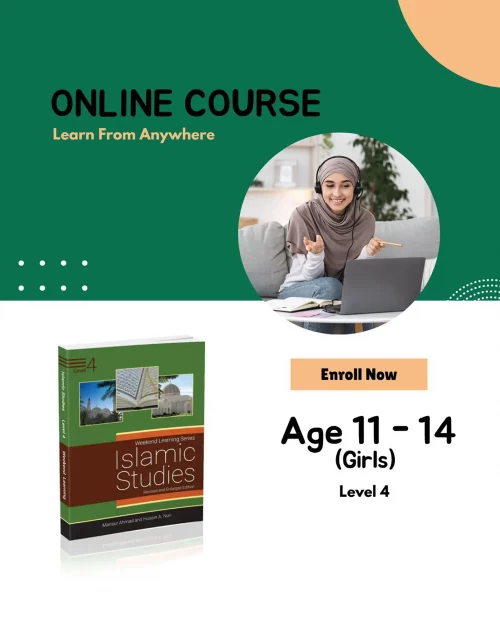
Level 4 – Term Dates and Fees (2026–2027)
Term 1
Schedule: Every other Saturday (alternating with Level 2) Times: 11.30am to 12.15pm Dates: 26th September 2026 – 19th December 2026 Sessions: 7 Teaching dates:
26th September 2026
10th October 2026
24th October 2026
7th November 2026
21st November 2026
5th December 2026
19th December 2026 Cost: £90
Term 2
Schedule: 2 sessions on Saturdays Times: 11.40am to 12.30pm Dates:
Saturday 30th January 2027 and
Saturday 6th February 2027 Sessions: 2 Cost: £30
Term 3
Schedule: 2 sessions on Saturdays Times: 11.40am to 12.30pm Dates:
Saturday 26th June 2027 and
Saturday 3rd July 2027 Sessions: 2 Cost: £30
Holidays and Breaks
Ramadan and Eid al-Fitr: 6th February – 8th March 2027
Easter holiday break: 30th March – 21st April 2027
Eid al-Adha break: 15th May weekend
End of Year Celebration Session: details will be shared closer to the time
Discounts
Annual Upfront Payment: £190 (excludes textbook and materials). Saves £20 and includes priority placement
Sibling Discount: 50% off if attending the same class
Trial Class
The first session is free for newcomers—a great opportunity to try the class before enrolling.
Upon booking you will be sent a link to buy the textbook.
Select options
This product has multiple variants. The options may be chosen on the product page
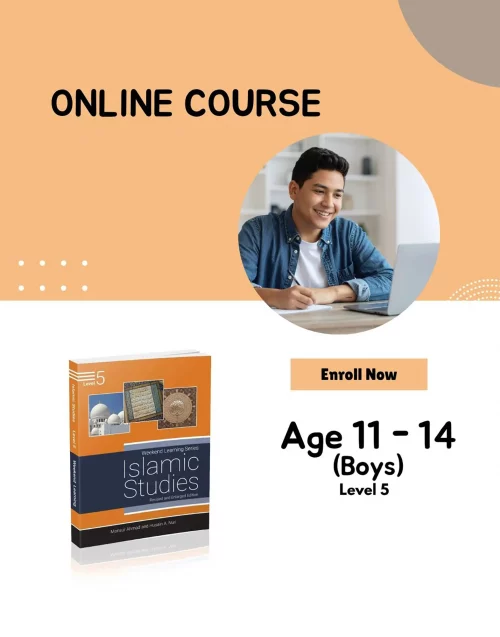
September 2026 – June 2027 Online Course | Blossoming Believers
Our Level 5 programme is designed for students who are ready to deepen their understanding of Islam and engage with more thoughtful discussions around faith, identity, and responsibility. At this stage, students begin to move beyond simple learning into reflection, questioning, and applying Islamic teachings to the world around them.
Through a carefully structured curriculum, students explore belief, the life of the Prophet ﷺ, Islamic values, and the challenges Muslims face today, all within a supportive and engaging environment.
Autumn Term (September – December)
Unit: The Creator and His Message
This term strengthens students’ understanding of their relationship with Allah سبحانه وتعالى and the purpose of revelation.
Topics include:
The Divine Names and Attributes of Allah
Understanding the signs of Allah in the world (Sunan of Allah)
The purpose of revelation and guidance
Students will reflect on:
How knowing Allah shapes our identity
Recognising Allah’s wisdom in the world around us
Developing a stronger connection with the Qur’an
This term lays the foundation for a conscious and meaningful relationship with Allah.
Spring Term (January – March)
Unit: The Prophet ﷺ in Madinah
In this term, students study the life of the Prophet Muhammad ﷺ during the Madinan period, focusing on leadership, community, and responsibility.
Topics include:
The establishment of the Muslim community in Madinah
The Prophet ﷺ as a leader, teacher, and judge
Key challenges faced by the early Muslim community
Students will learn:
What it means to lead with justice and compassion
How the Prophet ﷺ built unity and strength within the Ummah
Lessons from real historical events and how they apply today
This term helps students connect deeply with the seerah and understand its relevance in modern life.
Summer Term (April – June)
Units: Islamic Ethics, Values, and Contemporary Relevance
In the final term, students explore Islamic character and how to live as confident Muslims in today’s world.
Topics include:
Islamic ethics and social responsibility
Core values such as honesty, integrity, and accountability
Islam after the Prophet ﷺ and its relevance today
Students will:
Reflect on how Islam guides personal and social behaviour
Discuss real-life challenges facing young Muslims
Build confidence in expressing and practising their faith
This term encourages students to think critically, act responsibly, and embody Islamic values in their everyday lives.
What Your Child Will Gain
A deeper and more thoughtful understanding of Islam
Confidence in their Muslim identity
The ability to reflect, question, and apply Islamic teachings
Strong moral character rooted in Qur’an and Sunnah
Term Dates and Fees (2026–2027)
Term 1
Schedule: Every other Saturday Times: 12.30pm to 1.20pm Dates:
19th September 2026
3rd October 2026
17th October 2026
31st October 2026 (break)
14th November 2026
28th November 2026
12th December 2026 Sessions: Approx. 6–7 Cost: £90
Term 2
Schedule: 2 sessions on Saturday Times: 12:30pm to 1:20pm Dates:
Saturday 30th January 2027 and
Saturday 6th February 2027 Sessions: Approx. 2 Cost: £30
Term 3
Schedule: 2 sessions on Saturday Times: 12:35pm to 1:25pm Dates:
Saturday 26th June 2027 and
Saturday 3rd July 2027 Sessions: 2 Cost: £30
Discounts
Annual Upfront Payment: £190 (excludes textbook and materials). Saves £20 and includes priority placement
Sibling Discount: 50% off if attending the same class
Holidays and Breaks
Ramadan and Eid al-Fitr break: 6th February to 8th March 2027
Easter holiday break: 30th March to 21st April 2027
Eid al-Adha break: 15th May 2027 weekend
End of Year Celebration Session: details will be shared closer to the time
Select options
This product has multiple variants. The options may be chosen on the product page
Prepared for a reflective teenage class with discussion-based learning, practical application and contemporary relevance.
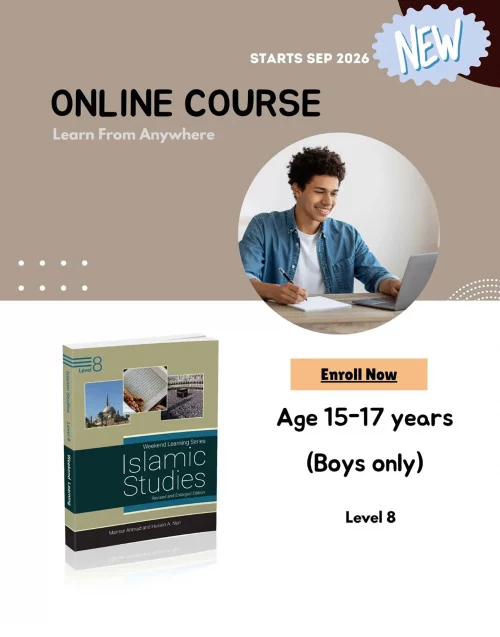
Online Course – Level 8 (Boys) Age Group: 15–17 years Class Time: Saturdays (Weekend Learning Series) Duration: 50 minutes Maximum Class Size: 8 students
Term Dates and Fees (2026–2027)
Term 1
Schedule: Every other Saturday
Dates: 19th September to 12th December 2026
Sessions: 6
Cost: £110
Taught by Ustad Abu Shama
Course Description
Anchored: Navigating Life with Faith, Character & Purpose
“An anchor keeps a ship from drifting. Faith keeps a person from losing their way.”
Anchored: Navigating Life with Faith, Character & Purpose is an interactive discussion-based course designed for young Muslim men aged 14–17 who want to explore life’s biggest questions through the lens of Islam.
Together we will explore:
How do we know what is true?
Why do we believe in Allah?
What makes Prophet Muhammad ﷺ worthy of following?
What is the purpose of life?
How do we build strong character?
How do we deal with doubts, temptations, and setbacks?
What does success really look like?
Drawing upon the Qur’an, Sunnah, and the rich intellectual and spiritual tradition of Islam, students will develop a deeper understanding of their faith while learning how to navigate the challenges of modern life with confidence and purpose.
This is not a lecture led series. It is a space to think, discuss, question, reflect, and grow together.
Through conversation, activities, and guided reflection, students will learn how to remain anchored in faith while charting a course toward a meaningful life.
About the Instructor
Ustadh Abu Shama is an educator, author, parent, and lifelong student of the Islamic tradition with a passion for helping young Muslims connect faith to everyday life.
Ustadh Abu Shama
Drawing upon years of teaching, and personal study, he is committed to creating engaging learning environments where young people feel comfortable asking questions, exploring ideas, and developing a thoughtful and confident understanding of Islam.
His teaching style combines traditional Islamic scholarship with discussion, reflection, and practical application, helping students move beyond simply learning information to developing faith, character, and purpose.
Through this course, he hopes to equip young Muslim with the tools they need to navigate life with conviction, resilience, and a strong connection to Allah and His Messenger ﷺ.
Suggested Teaching Approach
For this age group, the sessions work best when they are:
Discussion based rather than lecture heavy.
Connected to real teenage experiences.
Focused on identity, purpose and navigating modern society.
Built around reflection and action.
Linked to Qur’an, Sunnah and contemporary challenges.
Each session can include:
Icebreaker or current issue discussion.
Main teaching from the book.
Qur’anic reflection.
Real life case study.
Group discussion.
Action point for the week.
50 minutes online.
Autumn Term Schedule 2026
Session 1
Saturday 19 September 2026 12:30pm to 1:20pm
Session 1
How Do You Know What Is True?
Big Question
How do you know something is true?
Can something be true even if you cannot see it?
What counts as evidence?
Can everyone be right?
Discussion
Before we ask, “What do Muslims believe?” we must first ask, “How do human beings come to know anything?”
This session introduces students to the question of knowledge itself and lays the foundation for the rest of the course.
Are There Different Ways of Knowing?
Explore:
Senses
Reason
Testimony
Revelation
Intuition
Experience
Memory
Consensus
Learning
Introduction to epistemology and the Islamic theory of knowledge.
Eight ways of knowing.
Activity
Optical illusions and thought experiments.
Evaluate claims using different sources.
Outcome
Students appreciate that knowledge has sources and limits.
Understanding why revelation is a valid source of knowledge.
Session 2
Saturday 3 October 2026
What Does It Mean To Be Muslim?
Big Question
What makes someone a Muslim?
Learning
The Hadith of Jibril.
Discussion
Islam
Iman
Ihsan
Activity
Build a “Muslim Identity Pyramid.”
Outcome
Understand the three dimensions of religion. Plus eschatology
Session 3
Saturday 17 October 2026
What Do Muslims Believe?
Big Question
What happens if your beliefs are wrong?
Learning
Six Pillars of Faith overview.
Discussion
Allah
Angels
Books
Messengers
Last Day
Destiny
Activity
Belief mapping.
Seeing Allah
The who idea is to have Allah, his Names and attributes as a schema of life
Outcome
Big picture of Aqidah.
Half Term Break No Class 24 October – 1 November 2026
Session 4
Saturday 14 November 2026
The Case for God
Big Question
Why is there something rather than nothing?
Learning
The case for God.
Discussion
Cause and effect
Necessary existence
Design
Purpose
Simulation argument
Big Question
If Allah exists, how do we know Him or about Him?
Who is Allah?
Learning
Necessary attributes
Impossible attributes
Surah Ikhlas
Discussion
Why can’t Allah be human?
Why can’t Allah have needs?
Activity
Some questions about God and seeming paradoxes
Outcome
Understanding Tawhid
How Can We Know Allah?
Big Question
Can you know someone you cannot see?
Learning
Names and Attributes
Signs of Allah
Reflection
Discussion
Relationship vs information
Knowing about Allah vs knowing Allah
Activity
Reflection journal.
Outcome
Beginning a personal relationship with Allah.
Session 5
Saturday 28 November 2026
Why Should We Believe Prophet Muhammad ﷺ?
Big Question
How do we know Muhammad ﷺ was telling the truth?
Learning
Evidence for Prophethood.
Discussion
How do we know he is prophet
What’s so special about the prophet
Character
Quran
Predictions
Transformation of society
Activity
Historical investigation.
Outcome
Confidence in Prophethood.
Session 6 Sat 12th Dec
Why Follow the Prophet ﷺ?
Big Question
Why can’t we just follow the Quran alone?
Learning
Role of Prophethood.
Discussion
Teacher and Example
Interpreter and Implementer
Nurturer and purifier
Activity
How do we build a relationship with the prophet
How do we love him (following him)
Outcome
Understanding Sunnah.
Essential
Meet up once or twice in town Optional End of Term Additions
You may also include:
Hot chocolate reflection evening.
Student presentations.
Team quiz.
Charity or community project.
Suggested Homework Between Sessions
Because the classes are fortnightly, small reflective tasks help maintain connection:
One short Qur’an reflection.
Podcast or lecture clip.
Journal question.
Practical challenge.
Family discussion task.
Habit tracker.
Teaching Notes
For this age group especially:
Keep discussions respectful but honest.
Allow students to ask difficult questions safely.
Focus on understanding before memorisation.
Build emotional connection to Islam.
Link every topic to action and personal growth.
The aim is not simply information, but transformation.
Select options
This product has multiple variants. The options may be chosen on the product page
Course Schedule 2026-2027
Course
Age Group
Students
Start Date (2026)
Schedule
Time
Teacher
Notes
Level 2
7–10 years
Boys and girls
19th Sep
Every other Saturday
11:30am to 12:15pm
Ustadah Samia
Runs on alternating Saturdays
Level 4 Girls
11–14 years
Girls
26th Sep Every
Every other Saturday
11:30am to 12:15pm
Ustadah Samia
Runs on the alternate Saturday to Level 2
Level 5 Boys
11–14 years
Boys
19th Sep
Every other Saturday
12:30pm to 1:20pm
Ustadah Samia
Runs on alternating Saturdays
Level 8 Boys
15–17 years
Boys
19th Sep
Every other Saturday
12:30pm to 1:20pm
Ustad Abu Shama
Runs on alternating Saturdays
Grapey’s Journey Through the Five Pillars of Islam